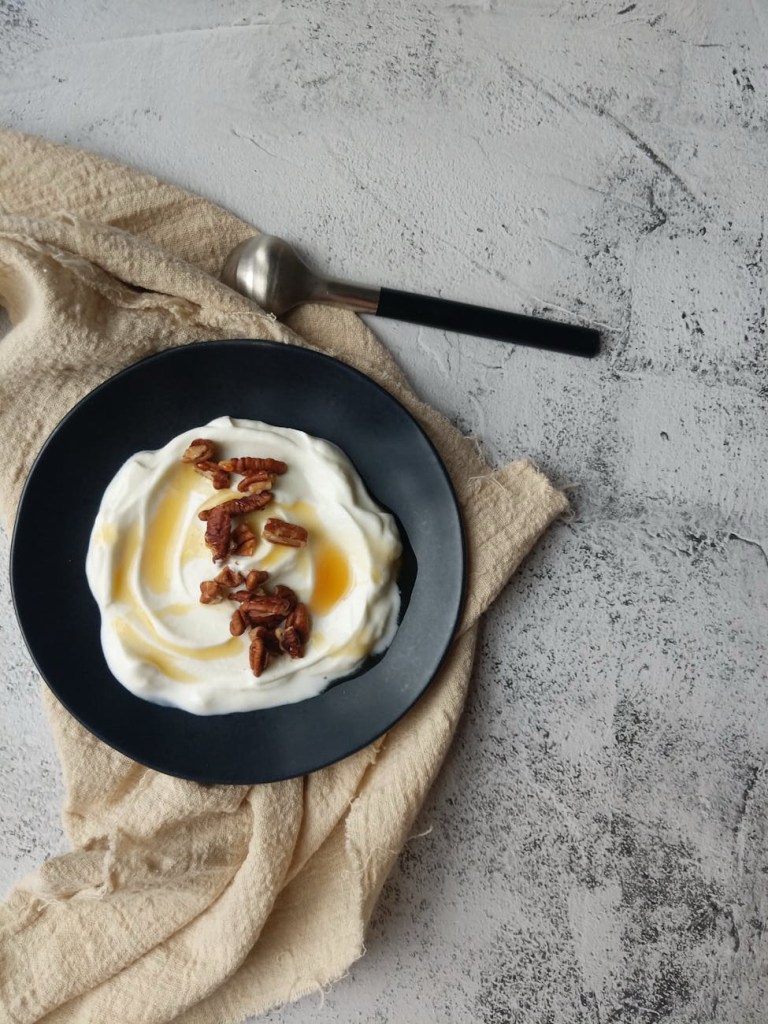
I made my own yogurt recently, and I must say that it was a bit of a fraught experience. My father, an avid homesteader, began making it a few months back and it was so easy that I decided to try it out, as I love, LOVE yogurt. Specifically, I love plain Greek yogurt with honey. The thick, creamy sourness balances beautifully with the sharp, gamey sweetness of the honey. It makes me feel decadent, like I’m getting a sinful dessert when in fact it’s quite beneficial. At any rate, I bought a yogurt maker from Amazon, a simple device that merely maintains a constant temperature in a water bath surrounding two glass containers. Then I stocked up on inulin, L. reuteri, and half and half and was ready to go.
Before I get too far into this journey, a quick overview of the supplies. Inulin looks rather like powdered milk, makes one’s fingers sticky, and is a food source for the bacteria that is necessary for yogurt production. L. reuteri is a variety of gut bacteria that, according to my father, are nearly extinct in the American gut. Lots of benefits and it is one of the varieties of bacteria that can produce yogurt. Finally, half and half. Any type of milk is fine but the higher the cream content the richer and thicker the yogurt will be.
As I dissolved the inulin in the half and half, crushed up L. reuteri pills, added water to the yogurt machine, and listened to the half dozen teenage boys, friends of my son, trash talk over a heated video game match, I never once thought that my first batch would not turn out perfectly. My father had extolled the ease of the process. A simple way to homestead. So thirty six hours later I opened the glass containers and saw thick glaciers of curdled milk floating in yellow liquid. If I had any doubts about the final product being spoiled, the sharp, nauseating aroma of rotten dairy assaulted me. A quick look around revealed that the yogurt machine had been unplugged. Hmmm. Teenage savages charging phones no doubt. Ok. No problem. I started again.
Thirty six hours later I got the same result. This time, the machine was still plugged in and there were no teenage boys to blame. I called my father and we discussed a number of possibilities, but the only thing we could come up with was that my “bugs” were dead. So, I headed up to my parents’ home a few hours away to make a batch with my dad. We used his yogurt as a starter. To clarify, if you’re starting from scratch you have to use the tablets to cultivate your own bacteria; however, once you’ve made your first batch, you can just use a few tablespoons per quart of half and half. This we did and set the timer for 36 hours.
In the time between, I spent a lovely time with my parents and my aunt, cousin, and her daughter. We ate and made our rounds to the local resale and antique shops. I bought a 5 gallon fermenting crock that I have no intention of using for fermenting. It will house cut flowers. We also saw an antique Griswold cast iron waffle maker for use over a gas stove. My aunt and I are collectors and became obscenely excited over it. My mom ended up buying it for my aunt for her birthday. Anyway, back to the yogurt. . .
At the beep of the yogurt maker, a thick, creamy yogurt was revealed. Success thanks to my dad! So if I had any takeaways for fledgling yogurt makers, I’d say the easiest route is to buy yogurt from the store to ensure live bacteria. The drawback is that L. reuteri varieties are hard to find. You can order this bacteria from Amazon, but there’s a chance your “bugs” might not live through the trip, which is what I believe happened to mine. Thank you rural USPS. At any rate, best of luck, should you decide to try making your own!!
 Five Dog Bend